
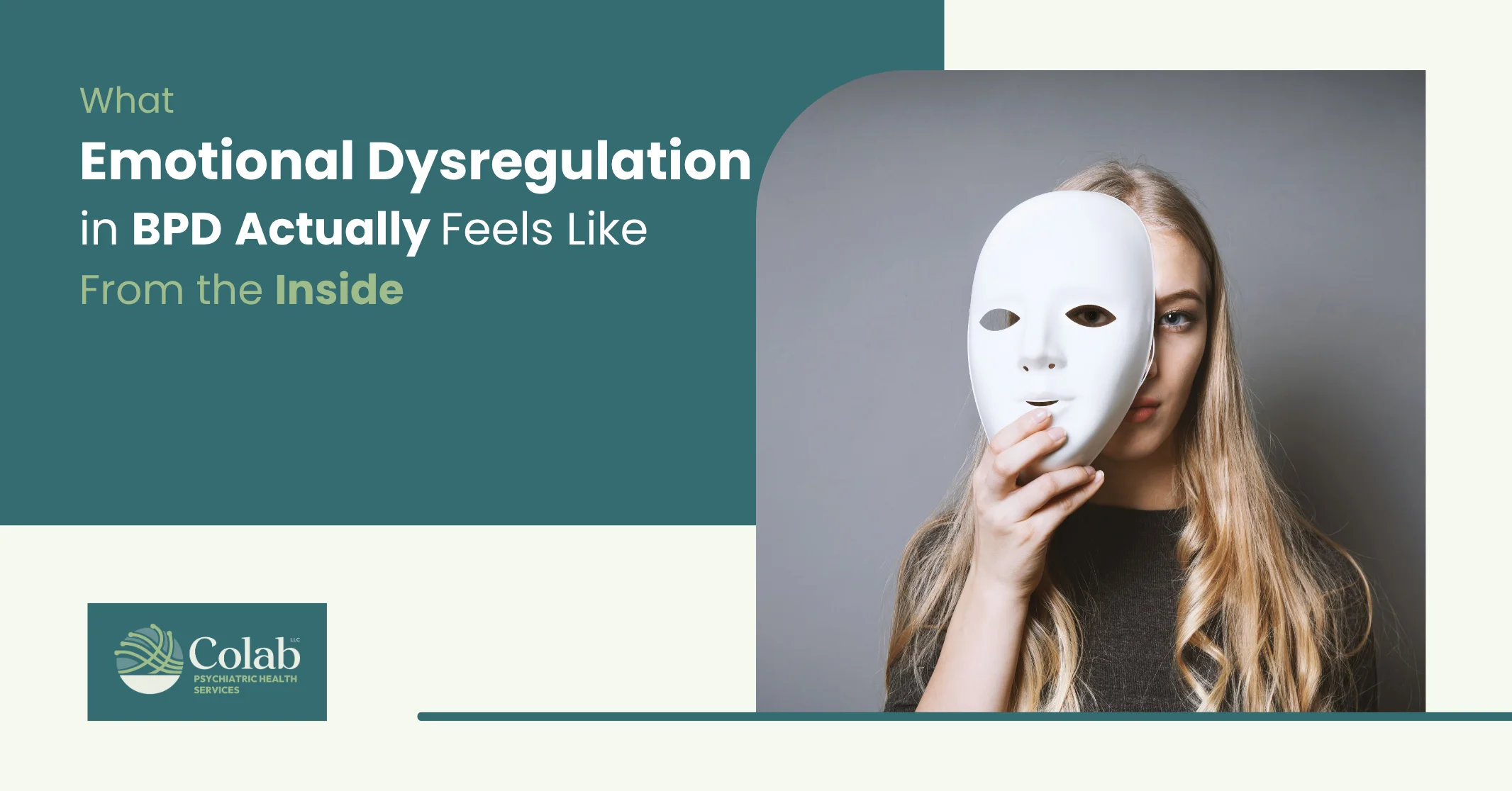
When you ask a BPD person to talk about, for example, a bad episode, most of the time they won’t start with a feeling. They start off by having a moment.
A text that sat unread for four hours. A friend who used a flatter tone than usual on the phone. A partner who walked out of the room during a conversation to answer a call.
So small that, if told out loud in the future, would make them sound almost silly to react so. But in the moment, it did not seem small. It was like the earth had split open.
That gap between the size of the trigger and the size of the reaction is where most outsiders get stuck, and honestly, where a lot of people with BPD get stuck, too.
The clinical term is emotional dysregulation.
Before You Know You Are Upset, You Already Are
There is usually no clean starting point. You do not sit down and decide to feel something. You notice, after the fact, that your jaw is tight, or that you have read the same message six times, or that you are already composing an angry reply in your head before you have even decided to be angry. The feeling arrives and announces itself as already in progress.
This is one of the hardest parts to explain to someone who has not lived it. It is not that the reaction is an overreaction to a small thing. From inside it, there is no small thing. There is only one thing, and it is enormous, immediate, and entirely convincing while it is happening.
It Does Not Build the Way Other Emotions Build
Most people experience feelings on something like a ramp. Irritation turns into frustration, frustration into anger, over the course of an hour or a day. With BPD, that ramp often is not there. Calm can turn into devastated in under a minute, with nothing that looks like a transition in between, no in-between stop where you could have caught it earlier.
- No real warning before the shift happens
- The feeling does not feel like one option among several, it feels like the only truth
- Trying to think your way out of it in the moment rarely works, even when you can see, almost from a distance, that it is happening
- After it passes, there is often a crash, not relief
This is also why advice built for ordinary anxiety, breathe for four counts, name five things you see, tends to fall flat here. Those tools assume there is a window before the peak. Often there is not one.
Getting Called “Too Much” Leaves a Mark
At some point, almost everyone with BPD has heard some version of the same thing. Too sensitive. Too dramatic. Too intense for normal life. It rarely gets said kindly, and it never gets forgotten. Over years, it stops being something someone else said and starts being something you believe about yourself before anyone else even has the chance to say it.
Here is the part that gets missed constantly: nobody is choosing this. No one wants to feel gutted over a delayed reply or shaking after a five-minute disagreement. The wish to feel normal, to feel proportionate, is usually right there, sitting underneath the panic the whole time. What is missing is not willpower. It is the part of the brain that, for most people, quietly handles this without being asked.
The Hours After Are Their Own Problem
People talk about the episode itself. They talk less about what comes after, which is sometimes worse. The replaying. Was that too much? Did I sound crazy? Are they going to leave now? Hours spent picking apart twenty minutes, looking for proof that you ruined something.
Shame settles in here more than fear does. Not shame about feeling things, but shame about how loud it got, who saw it, what they must think now. By the time the body has calmed down, the mind is often just getting started on a different kind of exhausting.
Why This Hits Relationships So Hard
Dysregulation rarely shows up evenly. It shows up hardest with the people closest to you, which is its own cruel irony. The fear of being left is often what triggers the very behavior that makes someone want to leave, and watching that cycle repeat does not make it easier to stop.
This isn’t someone being difficult for the sake of being difficult. In BPD, the links between attachment and emotional regulation are interwoven such that relational threat seems like mortal danger. It might appear overdramatic from the outside, but the nervous system is not exaggerating for effect. It actually thinks that what it is fighting for is high stakes.
Telling Someone to Calm Down Misses the Point
It is likely one of the most ubiquitous mid-episode things to say to someone, and among the least helpful. It assumes serenity is right there, it is available, if the person just chooses.
When someone is obviously dysregulated, the part of their brain that makes those sorts of choices has effectively gone offline. This is not unique to BPD. This is simply how a threatened nervous system operates, in general. What changes is the rate at which that line is crossed and how easily it can be done.
It Does Not Always Look the Same
Dysregulation is sometimes loud, bellowed rage, tears and slamming doors. At other times – it is the other way around: total silence, a bleakness that terrifies people more than the screaming ever could, because there is nothing to answer to. Grief can come unexpectedly, attaching no cause to it whatsoever.
Because of its unpredictable nature, the individual will struggle to be prepared for it. An otherwise innocuous comment delivers a crushing emotional blow on the worst day, and there is rarely one neat reason why.
What Helps
Dialectical behavior therapy exists specifically for this. Not to make someone feel less, but to build the skills to notice the wave earlier, ride it out without it taking over completely, and slowly change the relationship with the intensity itself. It is slow work, and it is also one of the most effective treatments available for this specific problem.
Medication also works, again often by dealing with what goes along with the dysregulation – anxiety, depression, sleep that is not playing nicely. In isolation, none of it works especially well.
What matters and what usually sticks is having a provider that has actually been on the opposite side of this before, somebody who doesn’t pull back at the sign, and somebody who does not simply treat the symptom in front of them but treats the whole person.
Reach Out
If this resonates with your own experience, you do not have to continue coping alone.
Structured and compassionate BPD care built around the individual, rather than the diagnosis – provided via Colab Psychiatric Health Services. Patrick Okeke, PMHNP-BC, actually listens to what you are going through before formulating a plan on how to deal with it.

No comment