
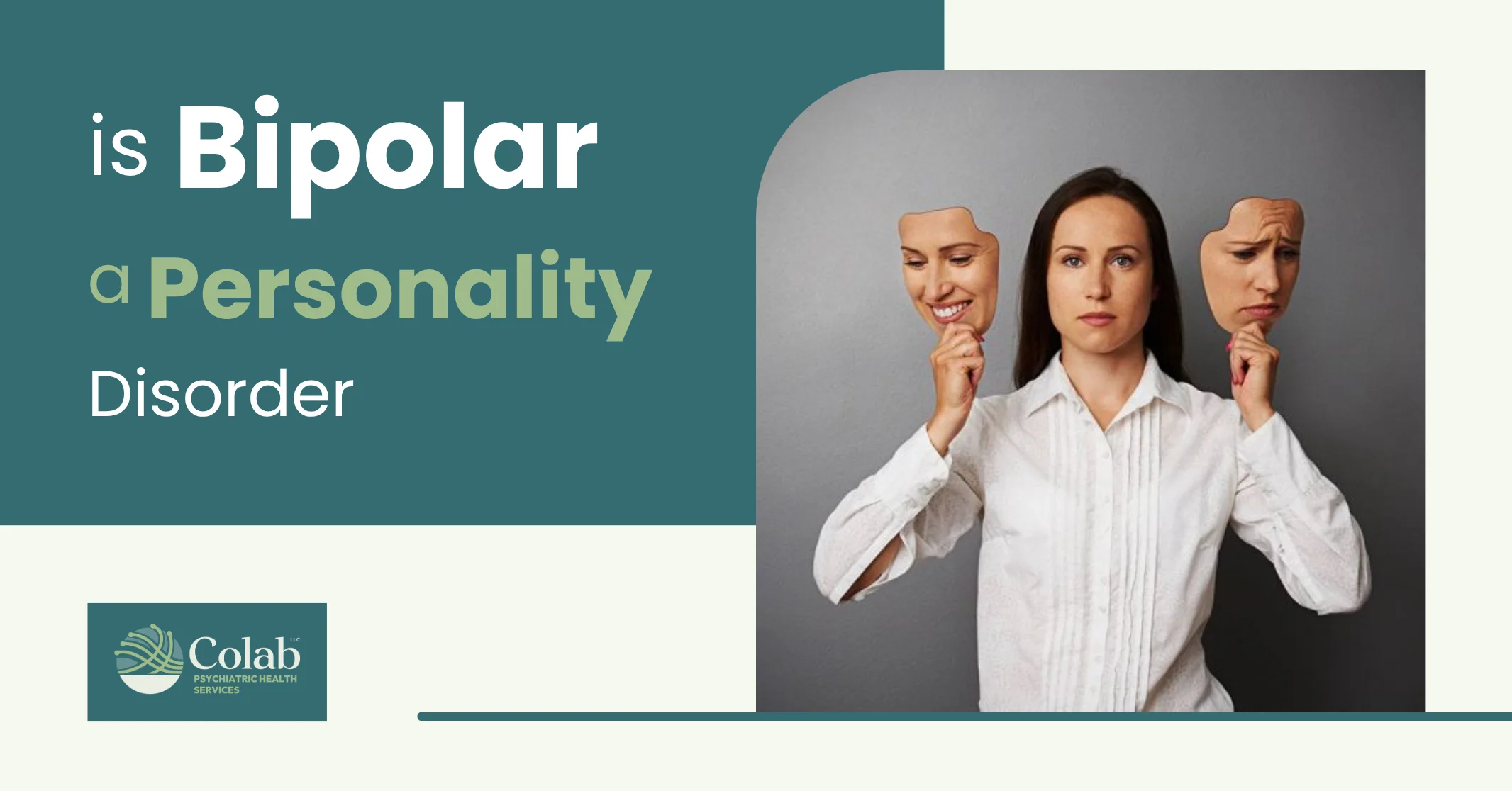
A patient’s brother once described her as “basically two people.” Confident and unstoppable some months, barely able to get off the couch in others.
He wasn’t wrong about what he was seeing, he just had the wrong word for it.
What he was describing was bipolar disorder, and the mix-up he made, bipolar and personality getting tangled together in casual conversation, is an extremely common one.
It’s not a personality disorder, though the two get confused constantly, for reasons that actually make sense once you look at why.
Is Bipolar Disorder a Personality Disorder? The Basic Distinction
Bipolar disorder is a mood disorder, which means it’s defined by episodes, specific, time-limited stretches of mania or hypomania and depression that are different from how a person normally functions.
Between those episodes, most people return to something close to their baseline self. Personality disorders work on completely different logic.
They’re not episodic at all. They describe a pattern, in thinking, relating, reacting, that’s simply always running, consistently, not in phases.
Why the Confusion Happens Anyway
Real symptom overlap is the actual reason this question comes up so often, not just public misunderstanding.
Emotional intensity, impulsivity, relationships that go sideways, mood that shifts fast, all of it shows up both in bipolar disorder and in certain personality disorders, borderline personality disorder in particular.
This is where a lot of the confusion between bipolar vs personality disorder categories genuinely originates, because from the outside, a mood swing looks like a mood swing regardless of what’s driving it underneath.
What separates them, in practice, is timing and trigger.
A manic episode tends to run days or weeks, often with no obvious external cause.
The rapid shifts sometimes described as BPD with bipolar features, or seen in BPD on its own, move much faster, sometimes within a single afternoon, and are almost always triggered by something relational: a perceived slight, an argument, a fear that someone is about to leave.
A clinician sorting personality disorder vs bipolar presentations pays close attention to exactly this, how long a shift lasts and what set it off, more than the mood symptoms themselves.
When They Show Up in the Same Person
Bipolar disorder and borderline personality disorder can and do coexist, and when they do, bipolar with personality disorder stops being a diagnostic curiosity and becomes a real treatment question.
Medication that controls mood episodes doesn’t touch the relational and identity patterns central to BPD, so treating only one side leaves real work undone.
The same layering shows up with bipolar with narcissistic personality disorder, mood episodes running alongside a long-standing, fixed pattern around self-image and how someone treats the people close to them.
These aren’t mutually exclusive categories, and figuring out which symptoms belong to which condition, or recognizing that both are genuinely present, is most of what a careful evaluation is actually for.
A Different Condition Entirely
One mix-up worth clearing up directly: bipolar disorder and what people sometimes still call bipolar multiple personality disorder are not related conditions.
What used to go by that name is formally dissociative identity disorder now, a separate diagnosis built around distinct identity states, typically rooted in severe childhood trauma. It shares no diagnostic category with bipolar disorder, no overlapping cause, and no overlapping treatment path.
The two just happen to both involve the word “personality” somewhere in how people talk about them, which is likely where the confusion originally started.
Why Getting This Right Actually Matters
This isn’t a distinction that only matters on paper.
Whether something falls under personality disorders vs mood disorders, it determines the entire treatment approach.
Bipolar disorder responds well to mood stabilizers and antipsychotic medication as the primary treatment, with therapy playing a supporting role. Personality disorders, BPD especially, respond best to structured therapy, dialectical behavior therapy being the most established, with medication playing more of a supporting part rather than driving the treatment itself.
Get the diagnosis wrong in either direction and the treatment plan points the wrong way. Months pass. Nothing improves. And it’s rarely because treatment failed outright, it’s because the wrong condition got treated in the first place, which is a genuinely common and genuinely frustrating outcome for patients who deserved better from the first evaluation.
What a Careful Evaluation Actually Looks Like
A real diagnostic workup goes well past a symptom checklist. It maps the timeline of mood episodes, what tends to trigger a shift and how long it runs, what a person’s baseline looks like when nothing’s active, family history, and how relationships and self-image hold up outside of any episode entirely.
The difference between mood disorder and personality disorder isn’t always obvious from a single conversation, which is exactly why that depth matters.
It’s what separates an accurate diagnosis from a guess, and it matters even more when more than one condition might genuinely be present at once.
If your diagnosis has never quite felt right, that’s worth a closer look.
Colab Psychiatric Health Services provides thorough psychiatric evaluation and treatment for bipolar disorder, borderline personality disorder, and co-occurring conditions. Patrick Okeke, PMHNP-BC, takes the time to get the full clinical picture right before building a treatment plan.

No comment