
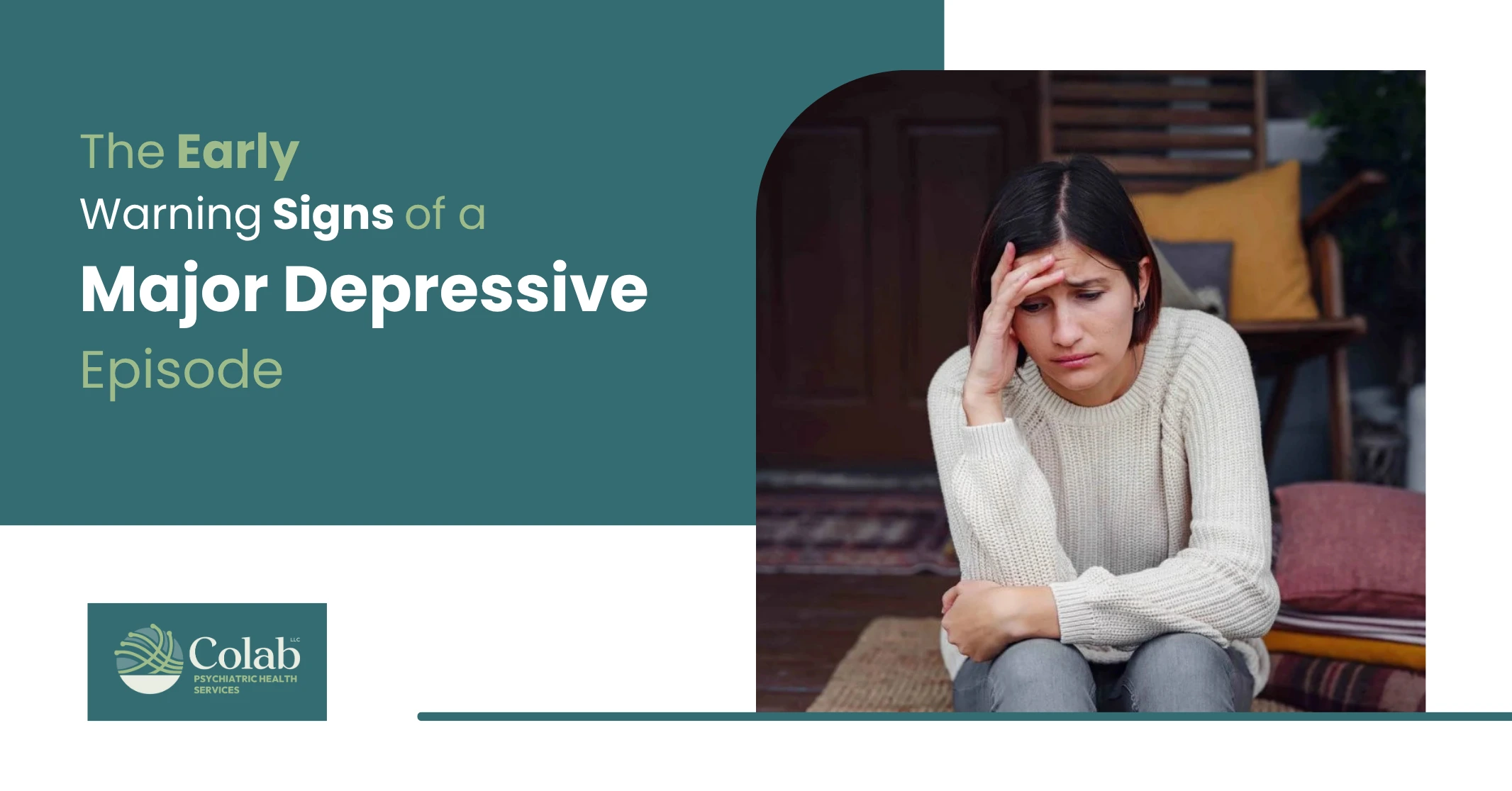
Depression rarely announces itself clearly. It doesn’t walk in and introduce itself. It tends to arrive in small subtractions.
The music you used to put on in the car that you’ve stopped reaching for. The texts from people you actually like sitting unread for days. The thing you always found funny that now just lands flat. None of these feel like a mental health emergency. They feel like a busy week, a low mood, the wrong season.
That’s part of what makes the early stage of a major depressive episode so hard to catch. By the time it feels significant, it’s often been building for weeks.
What “Early” Actually Looks Like
Most people’s understanding of depression is built around its most acute version. The inability to get out of bed. The complete withdrawal. The obvious crisis. That version is real, but it is rarely where things start.
Depression isn’t like just someone turning off the circuit; it’s kind of a dimming. Early depression often looks more like a steady fade out than an abrupt cut off. The things that used to come easily begin to take effort. The happiness does not go away in an instant. It fades just a bit more each week until eventually you realize that it has been many months since anything was even your own.
The clinical term for that is anhedonia. The loss of pleasure in things that used to bring it. It is one of the most reliable early signals of a depressive episode, and also one of the easiest to dismiss.
The Signs That Are Easy to Explain Away
How your body signals it first
The body often notices before the mind is willing to. Some things worth paying attention to:
- A tiredness that sleep doesn’t fix. Not sleepy-tired. Empty-tired.
- Appetite that has shifted with no real explanation, either eating past the point of hunger or forgetting to eat at all.
- Everything moving a little slower, your thoughts, your reflexes, your ability to find a word mid-sentence.
- Headaches, a low-grade tension, or a physical heaviness that doesn’t have an obvious source.
- Sleep that is either impossible to come by or excessive, and leaves you depleted either way.
How it shows up in your thinking
- Decisions that used to be automatic now feel genuinely hard to make.
- A quiet, persistent sense that things are not going to get better, without a specific reason attached to that feeling.
- Thoughts that are more self-critical than usual, and a reduced ability to argue back against them.
- Concentration that keeps slipping. Reading the same paragraph twice. Losing the thread of a conversation you were just having.
- Time moving strangely. Days that stretch too long and weeks you cannot fully account for, at the same time.
The Difference Between a Hard Stretch and Something More
Sadness is a response to something. A loss, a disappointment, a season of stress. It is proportional, and it moves.
What happens in a major depressive episode is different. The heaviness is not always tied to a specific cause. Or it started with one, and that cause has long since passed, but the weight is still there. That’s when duration starts to matter.
If this has been going on for two weeks or longer, and it is making ordinary functioning harder, that is the threshold clinicians look at!
Why Catching It Early Actually Matters
There is a tendency to wait until things are bad enough to feel justified in getting help. To hold out for rock bottom as the permission slip to take your own mental health seriously.
The problem is that depression compounds. The longer it goes, the harder it becomes to access the parts of yourself that would normally help you through it. The motivation to reach out. The belief that things could be different. The energy to make the call.
Early support is not about being dramatic. It’s about not waiting until you’re too depleted to act.
Colab Psychiatric Health Is Here
Patrick Okeke, PMHNP-BC, works with people in McDonough, Georgia who are navigating depression, anxiety, bipolar disorder, and more. The approach at Colab Psychiatric is collaborative and unhurried. Treatment is built around the person, not just the diagnosis.
If something has felt off and you’ve been waiting for it to pass on its own, it’s worth talking to someone. Not because something is definitely wrong. Because you deserve to find out either way.
Phone – (770) 525-5782
Email – patrick@colabpsychiatric.com

No comment